Abstract Gradient methods, which vary the composition of the mobile phase during a chromatographic run, can improve many aspects of a chromatographic separation, but require special equipment. Low pressure gradient systems use a series of proportioning valves to control the relative composition of the solvent flowing to a single pump. High pressure mixing systems use two pumps whose speeds are adjusted to vary the composition of their combined output to the column. Minimal dwell volume and high mixing efficiency are important to gradient quality.
KeywordsGradient, Valves, Pump, Mobile phase, Low pressure mixing, High pressure mixing, Mixing, Dwell volume
LevelBasic
Gradient separation requires that valves and/or  pumps be electronically controlled. We can classify gradient systems in low-pressure or high- pressure solvent mixing.
In low-pressure gradient mixing, the solvents meet before the pump head. The mixing chamber homogenizes the eluent and is placed before or after the pump. A single pump is equipped with 2 – 4 proportioning valves at the inlet of the pump. The valves alternately open and close. During the filling cycle of the pump, each valve is opened serially for a programmed "proportional" period to mix the desired amounts of the solvents. Not surprisingly, the fraction of each constituent is proportional to the relative time that its valve is open.
Low pressure gradient system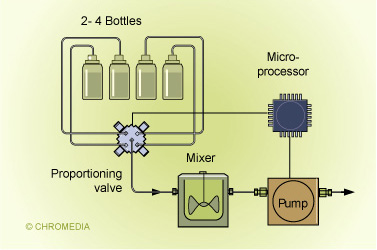
Low pressure gradient system
Optimal mixing with uniform viscosity depends on the shape of the proportional valves and on the construction of the mixer and the pump heads. In some cases an additional mixing chamber is placed just before the pump inlet to optimize mixing. Solvent mixing in low pressure gradient systems is usually very efficient, which improves the reproducibility of retention times.
Accurate mobile phase composition control requires valves with very short switching times. This is because a piston moves backwards and forwards dozens of times per minute, resulting in a refill stroke of a few seconds at most. Valve switching times of a few hundredths of a second are possible.
The individual liquids should be  degassed. If not, bubbles form in the mixing valves at low pressure. Ideally, a mixture of uniform viscosity is formed after mixing. This mixture is led through a pressure sensor in order to correct for the compressibility by instantaneously adjusting pump speed, thus maintaining a constant volumetric flow.
Accurate solvent composition requires valves with very short switching times. This is because a piston moves backwards and forwards dozens of times per minute, resulting in a refill stroke of a few seconds at most. Valve switching times of a few hundredths of a second are possible.
The individual liquids should be degassed. If not, bubbles form in the mixing valves at low pressure. Ideally, a mixture of uniform viscosity is formed after mixing. This mixture is led through a pressure sensor in order to correct for the compressibility by instantaneously adjusting pump speed, thus maintaining a constant volumetric flow.
In high pressure gradient mixing, the solvents meet downstream from the two pumps and there is a back pressure regulator behind the detector cell. Note that high pressure systems include a mixing chamber downstream from the pumps.
Solvent degassing is less critical in high pressure systems compared to low pressure systems.
In high pressure systems, at least two pumps work simultaneously, each pumping a different solvent. The proportion of solvents is controlled by the relative pump speeds. Both flows are homogenized in a small mixing chamber and any remaining pulsation is smoothed by a small pulse damper. The gradient program sends constant signals to each pump motor to correct the speed such that the pre-determined total volume flow remains constant.
High pressure gradient system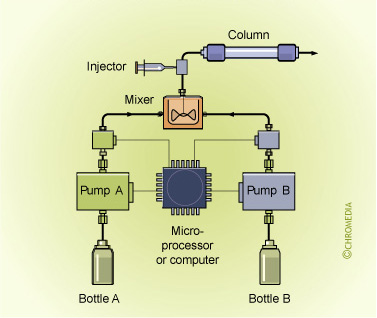
High pressure gradient system
The internal volume of the mixing chamber is an important part of the total "system volume". It determines the delay between the change in relative pump speeds and the onset of the actual change at the column. This is the so called "dwell volume" and is explained in more detail elsewhere in this content circle.
Although problems with air bubbles are unlikely in high-pressure gradient systems, degassing liquids prior to use is still recommended. Air dissolved in the mobile phase at high pressure can be released at the end of the column under the prevailing atmospheric pressure and will disrupt the detector signal seriously. You can connect a backpressure regulator at the outlet of the detector to prevent the formation of bubbles in the detector cell. This little device is attached to the end of the detector outlet line and sits in the waste reservoir.