Abstract Emerging already since a few decades, Ion Mobility Spectrometry (IMS) is an analytical technique initially developed for detecting traces of gaseous organic compounds in air. Comparable with Time-of- Flight Mass Spectrometry, the method relies on separation of ions on different drift velocities in an electric field as a result of their different masses and geometrical structures [1]. The importance of IMS grew significantly nowadays owing to its high sensitivity in detection and monitoring of explosive traces and narcotics, but also for its support in on-site investigations.
LevelBasic
Ion mobility spectrometry proves to be a simple but yet a powerful technique, using the measurement of gaseous ions mobility derived from various samples. The extensive use IMS analysers changed the course for detection and identification of harmful substances. Moreover, promising applications in terms of protein analysis and other medical applications support its great versatility and potential for the near future. The traditional working principle of IMS revolves around the concept of drift velocities of gaseous ions, derived from sample molecules in a weak electric field at ambient pressure [1]. In the first stage of the analysis, the formation of ions from sample molecules takes place as the samples need to be in a vapour phase. A soft ionisation method is employed, usually chemical ionisation, powered with a radioactive source such as 63Nickel [1]. Following the formation of ion clusters characteristic of the sample material, their injection into a ‘drift region’ takes place via an electronic ion shutter. In the drift region the ions travel at characteristic speeds that are related to the size and shape (collision cross section) of the ion clusters. Upon arrival at the collector, each ion species gives a specific signal allowing for the measurement of ion current as a function of arrival time [4]. Lastly, the ion mobility spectrum is formed as a plot of the ion current against the ion mobility determined from the drift velocity.
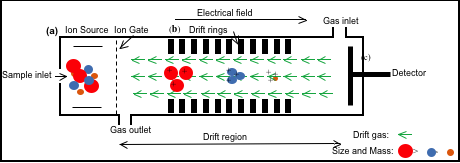
A conventional IMS showing three molecules of different size and mass entering through sample inlet, and ionized in the source (a). The ion gate opens and the charged molecules are pulled into the drift region by the electrical field. Molecules are separated based on their collisional cross section (b) and hit the detector at different times (c). Different ionization techniques such as atmospheric pressure chemical ionization (APCI), electron spray ionization (ESI) and matrix assisted laser desorption/ionization are commonly used for IMS. The most typical IMS is drifting time IMS (DTIMS), where ions move through a homogenous electric field in a drift tube colliding with a drift gas [2] (seen in Figure 1). Traveling wave IMS (TWIMS) is another type of IMS always coupled with a mass spectrometer (MS). TWIMS creates a voltage pulse across the ring electrodes that form a traveling wave for the ions to separate in. Field asymmetric waveform IMS (FAIMS) is the third most common IMS. High and low electric fields are applied to isolate ions of a specific mobility; all the other ions will be lost [2].
IMS coupled with a MS (IMS-MS) is used to separate ions by their mass, charge and collision cross section and detect mass to charge ratio (m/z). This leads to a powerful tool for separating isomers and measuring their mass [3].
A pre-separation can be done by hyphenating liquid chromatography (LC) or gas chromatography (GC) for complex samples. GC-IMS-MS is typically used in the military and airport security to detect explosives and chemical warfare agents, whilst LC-IMS-MS is used for environment pollutants, drugs and proteins analysis [5].
- Borsdorf, H., & Eiceman, G. A. (2006). Ion Mobility Spectrometry: Principles and Applications. Applied Spectroscopy Reviews, 41:4, 323-375, DOI: 10.1080/05704920600663469.
- Cumeras, R., Figueras, E., Davis, C. E., Baumbach, J. I., & Gràcia, I. (2015). Review on Ion Mobility Spectrometry. Part 1: current instrumentation. Analyst, 140, 1376-1390.
- Cumeras, R., Figueras, E., Davis, C. E., Baumbach, J. I., & Gràcia, I. (2015). Review on Ion Mobility Spectrometry. Part 2: hypented methods and effects of experimental parameters. Analyst, 140, 1391-1410.
- Smiths Detection. (2013, June 03). Technologies. Retrieved June 2015, 25, from Ion Mobility Spectrometry (IMS): http://www.smithsdetection.com/technologies/ion-mobility-spectrometry.html
- Stach, J., & Baumbach, J. I. (2002). Ion Mobility Spectrometry - Basic Elements and Applications. International Society for Ion Mobility Spectrometry, 5, 1-21.