Abstract Ionization is the process whereby neutral molecules are converted into charged species (i.e. ions). The conventional electron ionization technique can only be used for low to moderate molecular weight volatile compounds, while soft ionization techniques are suitable for the ionization of a wide range of molecules, regardless of their polarity, molecular weights, and are capable of creating both positively or negatively charged ions. Soft ionization techniques, especially atmospheric pressure ionization techniques (ESI, APCI and APPI), are well suited for HPLC/MS coupling.
KeywordsIonization, Molecular ion, Fragmentation, Electron ionization, Electrospray ionization, Atmospheric pressure chemical ionization, Atmospheric pressure photoionization, Matrix-assisted laser desorption/ionization
LevelBasic
An enormous number of compounds can be found in nature or are prepared synthetically. They can differ in molecular weights, polarity, volatility, thermal stability and many other physico-chemical properties. Because of this variety of properties, there is no perfect analyzer, and thus mass spectrometers employ a number of different ionization techniques. In fact, there are commercial instruments available with interchangeable ionizers so that the ionization technique can be tailored to the analyte.
Electron ionization (EI) was the first ionization technique used in MS, and is applicable only for volatile compounds since it is a gas-phase ionization technique. EI is considered a " hard" ionization technique because the excess internal energy deposited in the analytes during the ionization process may lead to extensive fragmentation and even to the total absence of the molecular ion M+. for ~10% of volatile organic compounds.
EI is mostly coupled to gas chromatography. This pair is particularly well suited for several reasons:
- GC and EI operate in similar concentration and polarity ranges,
- EI fragmentation allows identification of the
 peaks eluting from the GC column, a process simplified by the availability of extensive EI spectral libraries.
The ionisation principle of the EI technique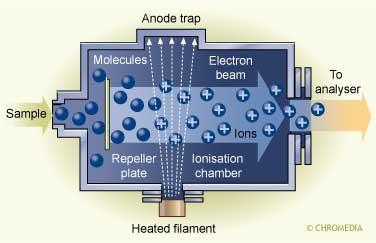 In EI a rhenium or tungsten filament heated to high temperature produces thermal electrons, which are accelerated towards an anode by establishing a potential difference. Large libraries of EI mass spectra are used for fast identification of unknown analytes. The high energy electrons interact with neutral molecules in the ion source, violently ejecting valence electrons, a process represented as:
M + e- → M+. + 2e-
In principle, EI has rather high vacuum requirements (about 10-5 Pa) to protect the heated filament, which would be burned at elevated pressures, and to avoid unwanted ion-molecule reactions within the ion source. The molecular and fragment ions formed in the ion source are forwarded to the mass analyzed region by the repeller electrode and a system of other focusing and acceleration electrodes referred to as ion optics.
Particle beam interface
HPLC/MS is mostly coupled to atmospheric pressure ionization techniques. Occasionally, however, EI is used with HPLC separations of moderately polar molecules in the 200-800 Da range (e.g. certain drugs and pesticides) in order to take advantage of EI spectral libraries. Such a measurement employs a particle beam interface to produce the gas-phase molecules required for EI. A particle beam interface transfers molecules to a gas-phase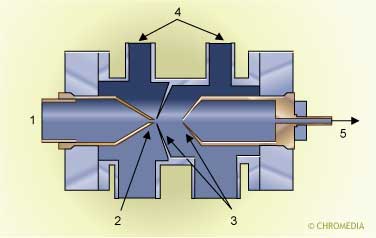 The HPLC effluent is:
- Nebulized by a stream of helium (1 and 2)
- Further evaporated in an evaporation chamber heated to about 50-80°C
- Separated in a two stage molecular jet separator (4).
- The lighter mobile phase and helium nebulizing gas are selectively pumped off (3) by vacuum pumps while heavier analyte molecules continue to the EI ion source (5).
Chemical ionization (CI) is the soft ionization technique used in GC/MS. It is a modification of EI whereby high energy electrons are first used to ionize a reacting gas, which goes on to ionize the analyte molecules. Fragment ions intensities are still higher compared to API techniques used for HPLC/MS coupling nowadays.
- The reaction gas is introduced in the ionization chamber at a pressure of approximately 50 - 100 Pa (~3x10⁻³ to 7x10⁻³ atm).
- Due to the excess of this reactant gas in the source, the accelerated electrons collide first with the reaction gas.
- The resulting reaction gas ions then react with the remaining neutral molecules of reaction gas by a series of ion-molecule reactions.
- These complex reactions will finally achieve a relatively steady-state composition of reaction ions (e.g. CH5, C2H5 and C3H5 for methane) which can finally ionize the analyte by ion-molecule reactions.
CI is used in either polarity mode and generates mainly even-electron ions, for example [M+H]+ in the positive-ion mode or [M-H]- in the negative-ion mode plus some fragment ions. Understanding this ionization mechanism is useful for the explanation of APCI and other modern soft ionization techniques.
ESI is the softest ionization technique and is well suited for biomolecules, organometallic compounds, non-covalent complexes, gas phase reactivity studies, etc. The introduction of electrospray has proven to be a great tool in biochemistry, allowing the mass spectrometric characterization and sequencing of peptides, proteins and other biopolymers of great importance to human life and medicine.
A high voltage separates the charged droplets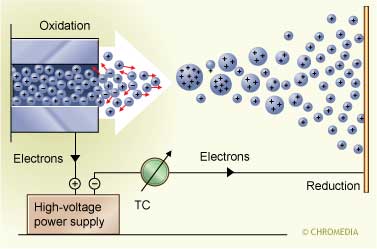 In an ESI source:
- The column effluent is directed through a stainless steel capillary.
- A high voltage is applied to the capillary (ca. 3-5 kV), which is kept in a coaxial flow of nitrogen nebulizing gas,
- Creating a fine aerosol of very small droplets, each of which carries many excess charges at its surface.
- The droplet size is further diminished in the ion source region with counter-flow of heated drying gas due to solvent evaporation from the droplet surface. In ESI the droplet size decreases, charged + ions are formed
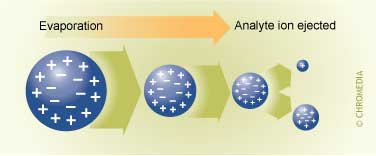
- When the charge density at the droplet surface reaches a critical value (the Rayleigh limit), a so called Coulombic explosion occurs and several even smaller droplets are formed, each carrying some fraction of the original droplet’s surface charge.
- The process of solvent evaporation, droplet contraction and Coulombic explosions is repeated until the molecular adducts are released from the final droplet.
The desolvation gas speeds up the evaporation and explosions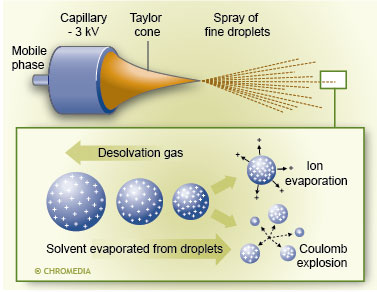 If a positive voltage is applied to the capillary, then the droplets will carry positive charges and finally positive ions are formed, such as [M+H]+ and [M+Na]+ adducts.
In the negative-ion mode, the base peak is typically the [M-H]- ion.
A set up with Nitrogen as 'drying gas' 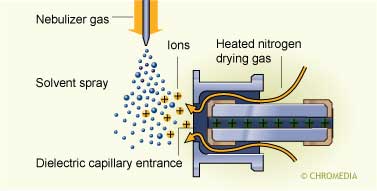
Because many mass analyzers (and ion detectors) have an effective upper m/z limit, ESI is notable for the formation of multiply charged ions, which significantly extends the mass range up to and beyond 100000 Daltons. This is of obvious importance to measurement of biopolymers.
An example: Let´s consider the simple example of a protein with a molecular weight MW = 60000 Da. The molecular adduct with for example 60 protons will provide a signal at m/z = (60000 + 60) / 60 = 1001. In practice, we observe a distribution of multiply protonated molecules, each with a different number of charges, as shown in the figure. We can easily determine the MW for unknown proteins using simple algebra:
- First, we assume that the ion at m/z 1049.8 carries an unknown number of charges x, which is related to its m/z by the equation: 1049.8 = (MW + x) / x.
- Likewise, the neighboring ion at m/z 991.5 carries an unknown number (x+1) of charges, giving the relationship: 991.5 = (MW+x+1) / (x+1).
The solution of these two  equations with two unknowns will yield both the charge numbers of the ions and the molecular weight of the protein.
ESI spectrum of multiply charged protein (Lysozyme)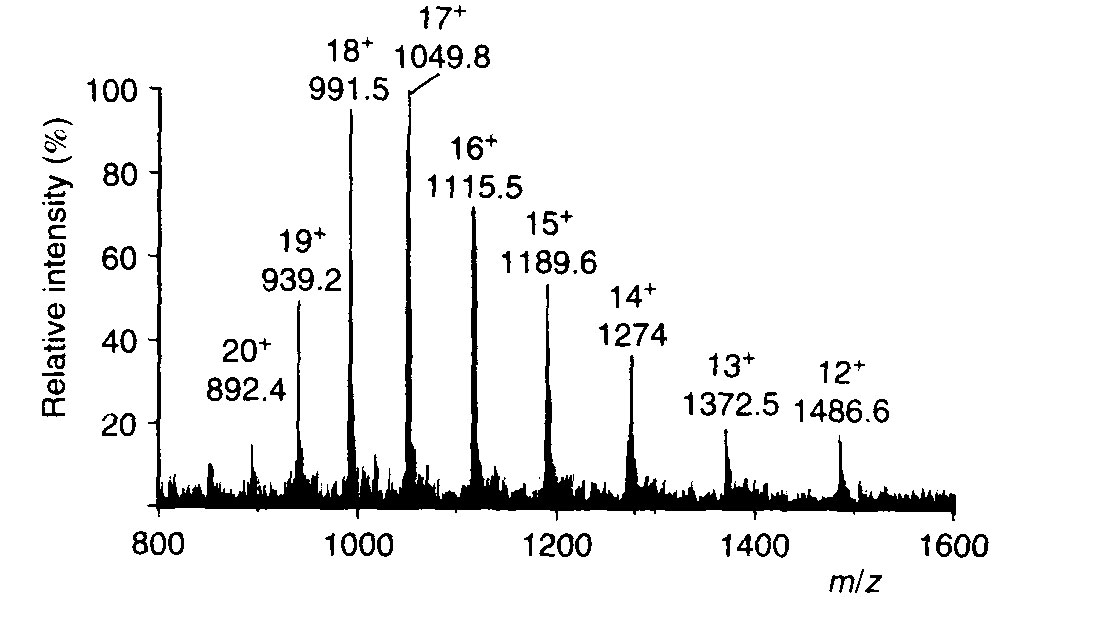
APCI is suitable for compounds ranging from very low to medium polarities with MWs up to 1000 - 2000 Da, which excludes biopolymers (e.g. peptides and proteins), organometallics, and other labile compounds.
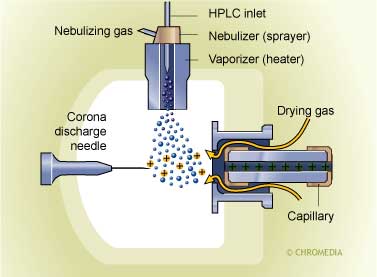
APCI sources are very similar in appearance to their ESI counterparts, but the principle is different. Unlike ESI, no voltage is applied to the capillary, but there is a heater for the evaporation of both analytes and mobile phase solvents.
- After nebulization and solvent evaporation in the heated chamber at about 300 - 500°C,
- The corona discharge created by the high voltage (ca. 3-4 kV) applied to a needle ionizes first the mobile phase components since they are present at much higher concentration than analytes. The formation of reactant gases is analogous to CI, but occurs at atmospheric pressure.
- Then, the ionized mobile phase species react with the analyte by ion-molecule reactions to generate analyte ions.
In APCI a needle is used to apply the voltage.
 As with ESI and other soft ionization techniques, mostly even-electron molecular adducts are formed, such as [M+H]+, alkali metal adducts [M+Na]+ and [M+K]+ or [M+NH4]+ in case of the positive ion mode and mobile phase containing ammonium additives/buffers.
In negative ion mode, [M-H]- is the predominate adduct ion.
The relative abundance of fragment ions in the full scan mass spectra is typically negligible, though somewhat higher in comparison to ESI mass spectra.
The construction and principle of APPI ion source is rather similar to APCI, but the krypton lamp is used as a source of ionization energy in place of the corona discharge needle. The ionization is rather selective.
A dopant (in this case, a compound with a low ionization energy) can be added post-column via a T-fitting, resulting in a high concentration of dopant ions in the source. The dopant ions ions then ionize the analyte molecules, as in APCI. This ionization technique is quite new and the precise ionization mechanism is still under investigation, but it shows a softer character in comparison to APCI and may extend the polarity range towards non-polar compounds and very labile compounds like saccharides.
In APPI
a light source induces ionisation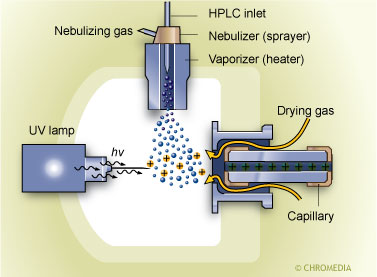
Matrix-assisted laser desorption/ionization (MALDI) is the other important tool for proteomic analysis. Although there are some technical solutions allowing on-line coupling with HPLC, there are several reasons why MALDI is preferably coupled to liquid-phase separation techniques in off-line arrangement.
In MALDI, a laser source 'evaporates' the sample components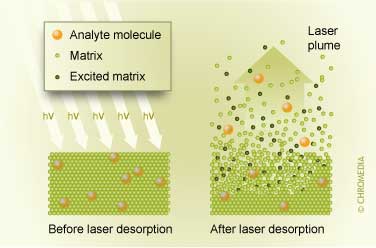 The principle of MALDI requires the use of matrix that absorbs light in ultraviolet region (for UV lasers) or infrared region (for IR lasers).
- For on-line coupling, the matrix has to be introduced to the column effluent usually post-column by a T-piece or by a second concentric tube in order to avoid band broadening.
- The off-line coupling techniques use standard MALDI plates with embedded matrix and an xyz positioning device.
The column effluent is deposited on the plate as a very narrow, continuous trace, or as discrete points at certain time intervals. The continuous line should not reduce the chromatographic resolution. The resulting MALDI plates with deposited HPLC effluent may be analyzed immediately and saved for reanalysis if some confirmatory or additional experiments are required for selected peaks. The positions of all peaks are precisely characterized by the speed of deposition device.
In HPLC/MALDI-TOF, the chromatographic trace is "saved" on the MALDI plate. MALDI ionization relies on the absorption of the laser energy by the absorbing matrix, which transfers energy to the sample, simultaneously desorbing and ionizing the analyte.
Typically, a nitrogen laser (UV 337 nm) is used with a matrix of UV absorbing aromatic acids, for example 2,5-dihydroxybenzoic acid, sinapinnic acid, α-cyano-4-hydroxycinnamic acid and other derivatives of cinnamic acid, etc.
Several other ion sources have been developed over the years and played a role in the development of HPLC/MS, but have been supplanted by newer, better ionization techniques.
Thermospray
The first step towards the routine use of HPLC/MS was the invention of thermospray ionization. This technique is similar to ESI in that is uses ion evaporation, though it differs in that the capillary is simply heated in lieu of applying a high voltage. Thermospray does not produce multiply charged ions and requires at least 10% water and ionic additives (e.g. ammonium acetate) in the mobile phase for the successful ionization. Thermospray has the advantage of working at relatively high mobile phase flows.
Fast atom bombardment (FAB)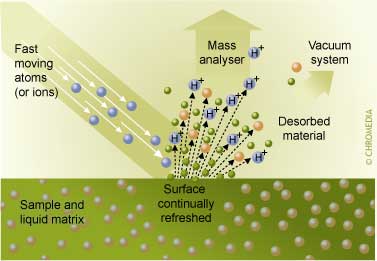
Fast atom bombardment (FAB) and fast ion bombardment (FIB)
FAB and FIB are two early soft ionization techniques notable for their ability to ionize thermolabile, highly polar, and high-mass compounds. In these two techniques, a beam high kinetic energy atoms (or ions) bombards a solution of analyte in viscous matrix (e.g. glycerol). Then, the complex process of collisions, desorption and ion-molecule reaction occurs results in the formation of even-electron molecular adducts similar to other soft ionization techniques. The HPLC/MS coupling was feasible, but only at rather low flow rates and with several caveats. These techniques were abandoned when the potential of API was realized.