Abstract HPLC systems consist of a high-pressure mobile phase pump, an injection system, a particle-filled analytical column, a detector and a data handling system. The pump moves a liquid mobile phase through the injection valve, into the column, which then separates the sample components. From the column the components pass to the detector. Data from the detector is recorded by a computer.
KeywordsIntegral, Modular, Detector, HPLC system, Data system, Column, Pump, Injection system
LevelBasic
An HPLC system has the following components:
HPLC principle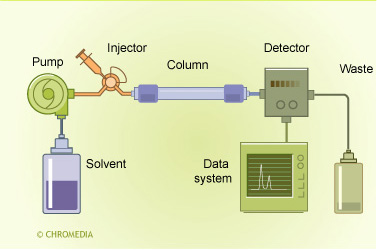
The sample is introduced via a high pressure valve which is switched on and off automatically. A capillary loop (sample loop) is filled at atmospheric pressure with a measured amount of sample while another portion of the valve shunts mobile phase directly to the column. The valve then switches so that the mobile phase flows to the column through the injection loop, moving the sample to the top of the column. The size of the loop determines the sample volume.
The mobile phase pump should operate at pressures up to 400 bar at flows of 0.05-10 ml/min. In many systems the pump can mix solvents from two to four reservoirs simultaneously. More complex system have a pump that mixes liquids from two or more different reservoirs at the same time in a predetermined  ratio. The ratio of the individual liquid flows is controlled electronically. After traversing a small mixing chamber, the mixture is pumped to the injection system. If the ratio of the various mobile phase components is varied with time, the system is said to be using gradient elution. Isocratic methods, on the other hand, use either a single, premixed mobile phase or a constant mixture of components drawn from various reservoirs. Two types of pumps are used in HPLC:
- Constant volume flow pumps
- Syringe type pump
- Reciprocating plunger pumps
- Reciprocating diaphragm pumps
- Constant pressure pumps
- Pneumatic pressure pump
- Column packing pump
Of these two types, constant flow pumps are most frequently used.
The analytical column is the heart of the chromatographic system. It has an internal diameter of 3 - 5 mm and a length ranging from 5 to 30 cm. The column is a tube filled with particles with diameters of an average of 3, 5 or 10 ¼μm. These particles act as the stationary phase. The use of smaller particles yields, in principal, columns with a larger separation power, but requires a higher pump pressure.
A detector is connected to the outlet of the analytical column and monitors the solvent emerging from the column. Detection is based on physical properties of the mobile phase and the sample components. Choice of  detector depends on the mobile phase, the sample to be detected and the sample matrix. The physical change which occurs in the presence of the sample component is converted into an electrical signal (current or voltage) which is sent to a data system.
A fraction collector can be connected after the detector to collect serial fractions with the component(s) of interest.
The data system not only stores the raw data from the analysis, but is also capable of controlling the complete instrument and the analytical process.
A HPLC system can be either integral or modular. In a modular system every component is interchangeable. A modular system is flexible and can be a blend of units from various suppliers. Components can be adjusted or interchanged in such a way that the HPLC system is optimized for a specific application. For example, there is an optimal detector for each type of analyte.