LevelBasic
Preventive measures
1. Be sure to filter the mobile phase and the sample solution with a membrane filter. You can use several apparatus for that:
Syringe filters
Prep bottles, Mobile phase filtration apparatus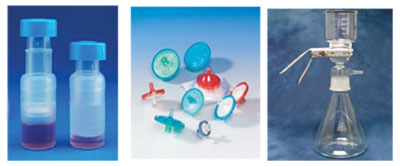
2. Degas the mobile phase and the sample. You have several options:
- On-line membrane degassing
- Helium degassing
- Vacuum filtration
- Ultra sonication
- Heating and stirring
3. Work clean and check:
- Prepare fresh mobile phase/checking amount of mobile phase needed
- Purge pump
- Flush column
- Check flow at detector outlet
- Check column pressure & stability
- Check stability detector
- Check pmax and pmin in method
- Perform a test run
4. Tips for practical use:
- All samples should be filtered
- Use HPLC grade solvents only
- Take care of miscibility of solvents
- Leave pump on (low flow) after running a series of samples
- Check system regularly with a system test
Not all peaks occurring in the chromatogram are necessarily sample components. Some are likely caused by:
- the mobile phase
- some may be caused by dissolved air (oxygen).
A difference in the amount of dissolved oxygen between the mobile phase and the sample solution makes an oxygen peak appear.
Example of an oxygen peak
The illustration compares chromatograms in which the samples were the mobile phase itself, which was processed to contain different concentrations of dissolved oxygen before injection.
Dissolved air in mobile phase may appear on the chromatogram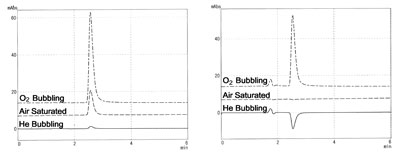 The mobile phase used consisted of a mixture of water and methanol, and in the case where the mobile phase was degassed online and delivered (left-hand figure), when the sample (mobile phase) was injected as it
  was, i.e., in the oxygen-saturated state, a single peak is evident in the chromatogram (about 10mAU when 10mL is injected). This peak barely appears when helium is bubbled through the sample (mobile phase) prior to injection (dissolved oxygen concentration approaches zero). In addition, when oxygen is bubbled through the sample (dissolved oxygen concentration reaches about 5 times that of when saturated with air), conversely, a large peak is generated. On the other hand, if the mobile phase is delivered without being degassed (right-hand figure), almost no peak is observed when the sample (mobile phase) is injected in the air-saturated state. Moreover, when helium is bubbled through the sample, a negative peak is observed. From these results, it can be concluded that a difference in the amount of dissolved oxygen between the mobile phase and the sample solution causes a peak.
Effect on absorbance
The absorbance of an organic solvent increases as the concentration of its dissolved oxygen increases. This effect is particularly evident in the short wavelength region.
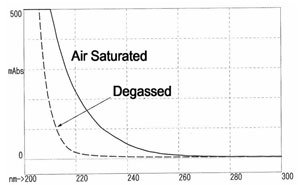 The illustration compares the absorption spectra of degassed and non-degassed methanol.
It is clear that when methanol is degassed, changes in the spectrum occur showing an overall decrease in absorbance. The difference in absorbance between the two varies depending on the wavelength. At 210nm it is greater than 300mAU, and at 254nm it is 10mAU. From these values, using methanol as the mobile phase, the height of the oxygen peak that is generated when oxygen-saturated methanol is injected can be calculated. If one chooses the triangular peak at 0.4 min at the base, under conditions of a flow rate of 1mL/min with a 10µL injection, the absorbance will be greater than 15mAU at 210nm, and about 0.5mAU at 254nm. From this, it can be expected that a considerably large peak will be generated in the short wavelength region.
The change in this absorption spectrum is also seen in other organic solvents, such as acetonitrile and tetrahydrofuran. Even in water or buffer solutions, while slight, it is still evident. However, the degree of change varies with the type of organic solvent used. In general, the higher the oxygen saturation concentration of the organic solvent, the more noticeable the effect, however, it cannot be said that the degree of the effect would be the same if the oxygen concentrations were equal.
Effect on elution and size of peaks
In reverse phase chromatography, as the percentage of organic solvent in the mobile phase decreases, there is a corresponding delay in elution of the peak derived from the dissolved oxygen, as well as a corresponding decrease in the peak area.
One may think that a peak derived from dissolved oxygen will elute sooner than other analytes. However, since oxygen is a non-polar molecule , as with other neutral compounds with similar retention behavior, elution becomes more delayed in reverse phase chromatography as the ratio of organic solvent composition decreases.
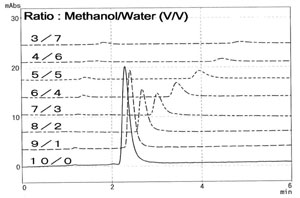 The chromatogram shows the changes in the elution time of the dissolved oxygen peak in a mixture of water and methanol as the water/methanol ratio is changed. The mobile phase was degassed, and on the other hand, the injection sample is a non-degassed mobile phase with the same mixture ratio. In this way, since the behavior of the dissolved oxygen peak becomes the same as that as the other organic compounds, depending on the situation, the analyte compounds can be affected by this peak to cause difficulty in performing the analysis. Now, as the percentage of methanol decreases, this peak becomes smaller and smaller, however, this is attributed to the fact that the oxygen saturation concentration becomes closer and closer.
Because the dissolved air in the mobile phase, and especially the oxygen, often becomes an inconvenience in the analysis, the mobile phase is normally degassed before use. Even if it is not degassed, since it is not possible for the dissolved oxygen concentration in the mobile phase and the sample to become equivalent, there is always a  possibility of the dissolved oxygen peak appearing no matter what the situation is. When developing the analysis method, it is advisable to inject a blank sample (sample solvent) beforehand to verify its elution position.
Quenching
Quenching in fluorescence detection is caused by collisions between the excited compound molecules to be measured and present oxygen molecules. The excited compound molecules which undergo collisions with oxygen return to the ground state without irridating fluorescent light. The effect of quenching is a lower fluorescence yield and a subsequent lower sensitivity. By degassing the mobile phase and the sample this effect can be avoided or at least reduced to minimum.
Excitation and fluorescence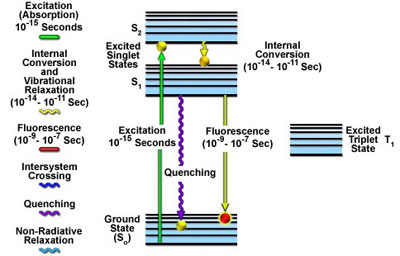 http://www.olympusmicro.com/primer/java/jablonski/jabintro/
Pressure fluctuations may be caused by the pump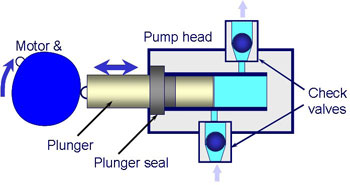
Possible reason for pulsation:
- Air in pump -> purge pump
- Seal leaks -> pressure test with closed outlet, if fails: replace seal
- Check valve malfunction caused by deposits in check valve
Check valve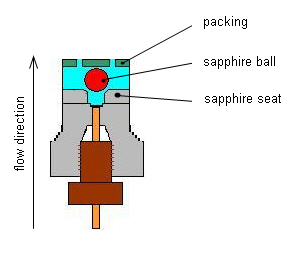 Check valve malfunction:
- Contamination of sapphire check valve seat or ball caused by:
- Polymerization process due to exposure to certain chemicals (e.g. acetonitrile, THF, chloroform)
- Insoluble matter from mobile phase bottle (e.g. dust, algae, bacterial vegetation)
- Crystallization of buffer solution (when performing gradient mixing)
Remedies:
- Ultra sonicate check valve with methanol
- Passivate system with 6N nitric acid (novia site)
- If everything fails: replace
 check valve.
System passivation is becoming a lost technique. Very few users will be willing to perform this procedure, but it can significantly improve the performance of the system.
The column pressure has increased. Should I replace the column? 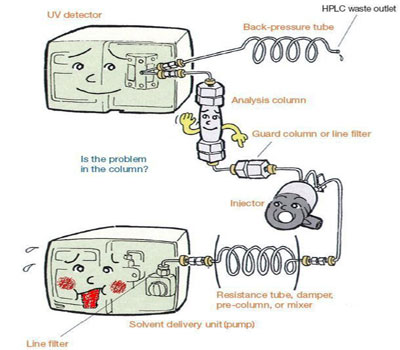
- In most cases Pmax has been reached and the pump stops.
- Evaluate the system as a whole but isolate each part systematically.
Evaluate  components, start with 1 and work your way upstream:
Evaluate components downstream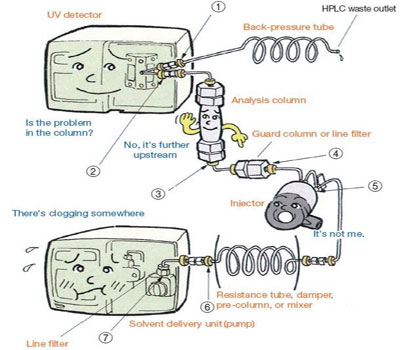 .
.
Clogging in the flow line
In order to identify the place where abnormally high pressure is occurring, the tubing is, in general, removed in order from the downstream end, solvent is delivered, and the pressure is checked. If the maximum pressure is reached quickly, the flow rate is lowered and the procedure is repeated.
- Connection (1) (back-pressure tube) is removed and solvent is delivered. If the pressure drops suddenly (by several hundred kPa or more), this indicates clogging in the back-pressure tube. If this does not drop, it indicates that the clogging is further upstream,
- Next, connection (2) (detector) is removed and investigated.
- After this, connections (3) (analysis column),
- (4) (guard column, line filter),
- (5) (injector),
- (6) (resistance tube, pre-column, etc.),
- (7) (solvent delivery unit’s line filter) are investigated in the same way.
In some cases, other connectors are removed. When checking the tube, cell, filter, or injector, there is a problem if a pressure of several hundred kPa occurs at the part itself. (A pressure of several hundred kPa may naturally occur in tubing for semi-micro systems.) Clogging may occur at filters and at the inlets to fine tubes and so these require particular attention. Flow line checks for the column oven interior are performed with the oven open, in other words, close to room temperature. Therefore, delivering solvent at the same flow rate used in analysis may result in too much pressure being applied to the column. It should normally be acceptable to deliver at around half the flow rate.
Clogging in the tubing
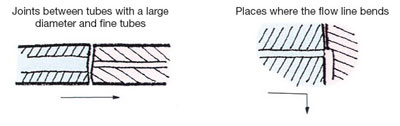
Parts prone to clogging include the junctions between tubes with a large inner diameter and fine tubes, and parts where the flow line bends. There are parts of the flow line where clogging can be rinsed away (i.e., dissolved) and parts where it cannot. In cases where it cannot, either the flow is reversed (by reversing the tubing) or that section of tubing is replaced.
There are many cases where the problem is solved by cutting a length of approximately 1 cm off the inlet end of the tubing. (Therefore, its is convenient to use a hand-tightened PEEK male nut for the connector and PEEK tubing.)
Replace tubing PEEK tubing is easily replaced. Advantages over stainless steel:
- Easy to cut
- Biocompatible
- Different internal diameters available
Disadvantages:
- Less pressure resistant
- Not suitable for certain solvents like dichloromethane, THF and DMSO which cause swelling
- Pressure resistance of PEEK tubing. Be aware of high pressure
P>220 bar PEEK tubing 1/16”OD 0.50mm ID was bend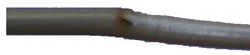
PEEK tubing can break at lower pressures than specified by manufacturers. Tubing is weaker where it has been bent.
Mobile phase issues
If white turbidity is visible in the mobile phase bottle, it is probably insoluble matter that has build up in the flow line. Although there is a suction filter, build up occurs because the downstream filter pores are often smaller. Even if the mobile phase is filtered, deposition may occur later if there is little leeway in the solubility of the solute. On the other hand, using only purified water may result in the propagation of bacteria.
With the gradient elution of buffer solution and organic solvent, use a beaker or a flask to check beforehand that there is no deposition after mixing. Depending on the mixing ratio, white turbidity may even occur when organic solvents are mixed together. If white turbidity or deposition occurs, in addition to rinsing the flow line, reconsideration of the mobile phase is also required.
- Troubleshooting is solving a problem systematically.
- Use a reference e.g. chromatogram of column manufacturer
- Work systematically
- Analyze source of error one by one
- Recognize the problem, then:
- Analyze
- Correct
- Check again (if not solved, go back to recognize)
- Problem solved
- Change only one thing at a time. If you are troubleshooting a problem by replacing parts, replace them one at a time. If you replace two parts and the problem is fixed, which part was defective? Would you then be discarding a good part? Would you be wasting money installing a new part for a functioning old part?
- A problem is not a problem until it occurs at least twice. Confirm the problem before fixing it. HPLC is a technique that is full of one-time anomalies. Don’t suspect you have a problem unless the situation repeats itself. Problems that cannot be repeated also cannot be diagnosed.
- Write it down! When troubleshooting problems, an accurate record of usage and system parameters can be very helpful to see if the problem has been developing gradually or has happened suddenly.
- Preventive maintenance saves more time in te long run. An HPLC cannot be treated as a black box. Exchange items like plunger seals after the pump has pumped a certain amount of mobile phase or after a certain time even if the HPLC has not been used for a longer time, as seals are prone to wear.
- Buffer rule: remove buffers from the HPLC when it is not in use. Flush system and column afterwards thoroughly with mobile phase without buffer. In all cases refer first to the information delevered with the column by the column manufacturer before flushing the column with another solvent than the suggested mobile phase.