Abstract Band broadening is an important phenomenon in HPLC separations. The band broadening of a chromatographic peak consists of two different and independent contributions: the column and the extra-column or external band broadening processes. Decreasing column dimensions has a number of advantages, but miniaturization puts constraints on maximum sample size and allowable extra-column dead volume. The sample capacity of a column (Qm) is the maximum volume of sample that can be introduced without column overloading and is proportional to column length and the cross sectional area. Smaller columns necessitate lower extra-column dead volume. Detector cell volume is an important extra-column factor.
KeywordsColumn dimensions, Sample capacity (Qm), Column volume, Porosity (å), Asymmetry, Column overloading, Loading capacity, Peak broadening, External broadening, Dead volume, Void volume, Peak volume (Vp), Retention factor, Efficiency, Detector broadening, Particle diameter
LevelBasic
Column dimensions affect the operational conditions of the HPLC system. Many factors can cause peak broadening and asymmetry and disturb the quality of the separation:
- Void volume (also called
 dead volume)
 - Volume overloading
- Large detector volumes
These are discussed in the next paragraphs.
Obviously the column parameters strongly influence the capacity and the performance of a separation method. One of the relevant column parameters is the  sample capacity. Column dimensions, e.g. a large diameter and to a lesser extent, a longer column, increase the sample capacity. This is demonstrated in preparative LC where
  wide-bore columns are used.
- The column volume
- Retention factors
- The sample concentration
- The ionic state of the analytes

where Cm is the analyte concentration in the mobile phase and ε is the porosity of a packed column. For many HPLC columns, ε may range in between 0.35 and 0.85
Volume overloading
Especially when the analyte concentration in a sample is low, large injection volumes may be necessary for an adequate analysis. Too high injection volumes however may cause excessive and asymmetric peak broadening and also may disturb the equilibrium between the column and the eluent.
A problem of sample overloading is the increased risk of the occurrence of peak asymmetry. An injection that causes peak asymmetry in excess of 10% of its original value exceeds the sample capacity of a column.
Overloading of HPLC column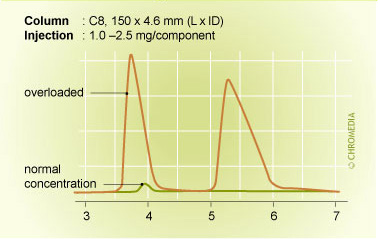 The sample capacity is proportional to the cross sectional area of a column, and, thus, to the square of the diameter of it. The loading capacity of a 4.6 mm ID column is in the range of 1 – 10 mg per component. For a 20 mm ID column, the sample capacity may increase up to 20 – 200 mg per compound. In practice under optimized chromatographic conditions for this latter column dimensions the sample capacity can be increased up to 1 gram per peak.
The injection system, the detector, the guard column and the column connections all contribute to the final peak broadening in a chromatogram. Particularly in this respect dead volume, also called void volume, in the sample flow path plays an important role.
For the overall band broadening σ2total it holds :
σ2total= σ²column+(σ²injection+ σ²detection+ σ²connection)
σ²total = σ²column + σ²external
where σ² is the variance (i.e. peak width in either volume or time units) contributed by each part of the system. Ideally no external band broadening exists and peak broadening is only determined by the internal band broadening processes in a column. Assuming a maximum loss of 5 % in resolution by the external band broadening processes it holds :
σ² external < 10% σ²column
External band broadening effects may cause  a maximum loss of the plate number of a column of 10% .
The peak volume (Vp) is the volume of the mobile phase containing the component of interest. Peak volume is essentially the peak width at the base, measured as a volume. For the peak volume it holds :
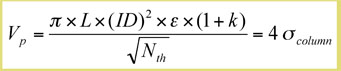
As can be seen from this formula peak volumes decrease with:
- low retention factors
- high column efficiency
- small column volume
In the following situations, external band broadening should be suspected as a source of significant peak broadening:
- Early eluting peaks show relatively larger peak volumes compared to later eluting peaks.
- Column efficiency significantly drops more than 10% of its original value.
- Excessive peak broadening or asymmetry is observed.
The dimensions of a column impact many other parameters. The table shows a few examples. A reduction of the column diameter has a large impact on the eluting peak volumes (large volumes will show up in the chromatogram as wide - broad - peaks).
Comparison of column dimensions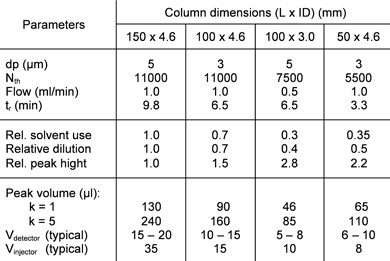
| Column (L x ID) (mm) | Peak volume k = 1 | Peak volume k = 3 | Maximum detector |
| 250 x 4.6 | 200 | 380 | 20 / 38 |
| 150 x 4.6 | 150 | 300 | 15 / 30 |
| 200 x 3.0 | 75 | 150 | 8 / 15 |
| 100 x 3.0 | 52 | 100 | 5 / 10 |
| 200 x 2.0 | 20 | 40 | 2 / 4 |
| 250 x 1.0 | 15 | 2 / 2 |
Some rules of thumb:
- Detector cell contribution is insignificant as long as the cell volume is smaller than 1/10th of the eluting peak volumes with a given column.
- Standard UV detectors have cell volumes between 5 and 10 µl. The table indicates that these cells are acceptable for column of 3 mm ID and larger.
- For 2 mm mini-bore columns, a special 2 – 5 µl detection cell must be installed. In the case of micro-bore columns (ID < 1.0 mm), a specially designed detector is required, as well as short, narrow-bore tubing and column connections.
In addition to the external volumes mentioned, attention should be paid to the speed of the electronics during detection and data processing. This includes parameters such as time constant, rise time, and sampling rate. For an adequate data acquisition these and also other parameters must be set properly and accordingly to the profiles and widths of the chromatographic peaks to be sampled.
Test system band broadening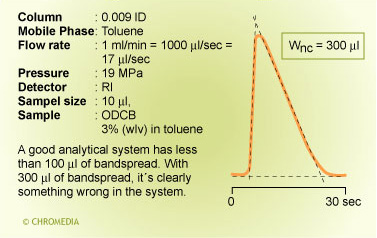 Waters Corp