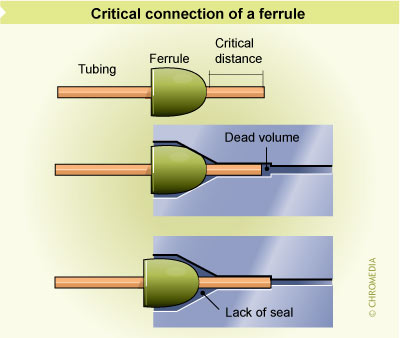
Abstract Proper selection and use of connecting fittings and capillaries is important to HPLC. When using PEEK or stainless steel fittings to join capillaries and components, care must be taken to avoid damaging system components or creating dead volume in the system. Overtightening fittings can damage expensive equipment. Mixing fittings from various manufacturers in the same joint can lead to dead volume.
KeywordsNuts, Ferrules, Fittings, PEEK, Stainless Steel, Dead volume, Peak tailing, Teflon, Capillary
LevelBasic
Most fittings used in HPLC are the SS-compression type, consisting of nuts and ferrules. A number of brands are available, including the following materials and manufacturers:
- Metal fittings
- Valco
- Rhyodyne
- Swagelok
- Waters
- Plastic fittings
- PEEK
- Kel-F
- Tefzel
To seat a new ferrule on a 1/16" capillary it is sufficient  to hand-tighten the nut in the fitting and then tighten it 3/4 of a turn further with the correct spanner (inch size!). Once a ferrule has been seated the first time, it usually needs only 1/4 of a turn to make a leak-tight connection. In all cases, remember that excessive tightening leads to damage to the fittings and threads and eventually to leaks.
"Plastic" fittings made of PEEK (poly[ethyl ethyl ketone]) are very popular nowadays in HPLC systems. They can be connected hand tight and are leak resistant up to 200 bar. Another advantage is that PEEK fittings are universal, so they fit on all types of columns and hardware.
Although a number of manufacturers have standard thread sizes (10/32 UNF), the shape and length of the ferrule and the insert length of the capillaries (1/16") or metal column are so widely dissimilar that fittings from different manufacturers should not be mixed. It practically always causes problems, e.g. a excessive void volume if the male fitting does not completely fill the female end. Improperly matched fittings can result in leakage or dead volumes (tailing peaks). The use of steel nuts and ferrules has the  drawback that once they are connected to a capillary they cannot be removed.
PEEK or teflon ferrules can be used to connect the column and detector as well. If they are used with care and not turned too tightly, these can be removed from the capillary and can be used several times.
As mentioned before, there are PEEK fittings made in a single piece (nut + ferrule) which can be hand tightened. They can resist a pressure up to 20 MPa. The single piece is not tightly fixed to the capillary and can be used several times.
Some standard nuts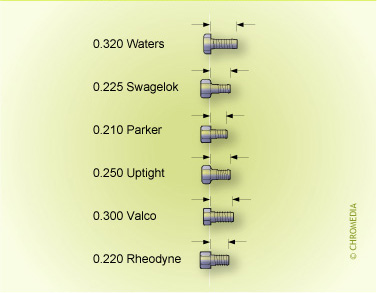
The length of the 'female' column fitting and the length of the ferrule determine the length of the nut and the protruding length of capillary. It is recommended that nuts and ferrules be of the same type.
Unfortunately, there is little uniformity between the column suppliers.
Different ferrules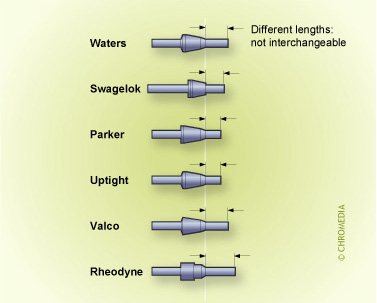
HPLC capillary tubing is also available in PEEK. The different internal diameters can be recognised by the colour codes of the tubing. IDs are available in the of 0.06" to 0.030" with an outside diameter of 1/16 inch.
A square cut of the connection lines is important to avoid dead volumes and tailing of the peaks in the chromatogram. Special tools are available for easy cutting of the capillaries.