Abstract Chromatographic techniques combined with mass spectrometry detection became the major analytical tool in biology research. Electrospray ionization (ESI) and matrix-assisted laser desorption ionization (MALDI) are preferred ionization techniques for analysis of high mass compounds, such as proteins or synthetic polymers. While ESI is usually chosen for on-line coupling of column separations to mass spectrometry (MS), MALDI is used for MS screening of large number of samples. Certain features of MALDI, however, make it more attractive in some applications. This chapter focuses on coupling of column separations to MALDI MS.
Keywordsoff-line, in-line, on-line, coupling, interface, LC-MALDI, column techniques, archiving
LevelBasic
While ESI is directly suitable for on- line analysis of liquid samples and is routinely used for coupling of mass spectrometry with separations, MALDI analysis is typically based on dry samples mixed with a suitable
  matrix.
For some applications, certain features make MALDI more attractive than ESI:
- MALDI spectra, dominated by singly charged ions, are simpler and easier to evaluate.
- MALDI, in conjunction with TOF mass spectrometer and high repetition rate lasers, allows extremely fast analyses.
- Solid samples prepared on MALDI targets can be archived.
Coupling of separations with MS represents one of the most powerful analytical systems available; since a mass spectrometer running in MS or MS/MS mode can provide:
- Unequivocal identification of the separated analytes.
- Higher resolution of the analysis
- Separation of the sample components prior to the MS analysis minimizes one of the potential for the signal suppression due to the bulk sample components (salts) and charge competing sample components.
The column chromatographic techniques can be coupled to MALDI MS in off-line, in-line or on-line modes:
Unlike the ESI, the MALDI is typically performed in the deep vacuum inside the mass spectrometer. Therefore the analysis is most frequently conducted off-line by collecting effluent fractions exiting the separation column.
The fractions are usually deposited directly onto a standard MALDI target. Matrix is typically added into the stream of effluent using mixing tee, sheath flow interface or liquid junction. Alternatively, matrix may be deposited on the target prior to or after deposition of effluent. Standard matrices with proven utility for given analyte in common MALDI MS experiments are chosen, i.e. a-cyano-4-hydroxycinnamic acid is employed in analysis of peptides and small proteins.
Effluent deposition. 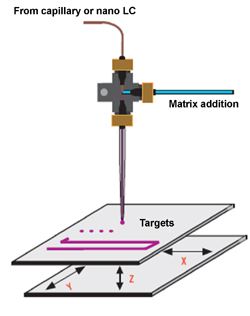 Concentration and flow rate of make-up matrix solution may need to be optimized. The deposited fraction aliquots are analyzed using a standard MALDI target. Thus, in the case of off-line coupling, separation and MS detection are mutually independent processes and can be carried out in different times and places.
Off-line coupling is the most popular with column liquid chromatography, capillary electrophoresis or two-dimensional separations due to its simplicity. Materials used are:
- the most common reversed phase packings
- size exclusion columns
- cation or anion exchange columns.
HPLC columns provide sufficient quantity of material and commercial fraction collectors and robotic stations are available on the market from virtually all manufacturers of MALDI TOF mass spectrometers.
Deposition.
A variety of deposition approaches exists. Effluent may be deposited in the form of separate fractions or as a continuous streak. The deposition probe may be in physical contact with target or work in contact-free mode. Effluent is transferred to target due to inertial, pressure or electric (constant or pulsed) forces. Deposition occurs usually at atmospheric pressure, less frequently in subatmospheric pressure or at vacuum.
Microfabrication.
New features into standard MALDI process were introduced by microfabrication. The structures microfabricated on the surface of the MALDI target allow precise positioning and concentration of sample microspots resulting in improved sensitivity and repeatability of the analysis. Completely automated systems integrating microfabricated MALDI plates, piezoelectric dispensers, enzymatic reactors, HPLC separations etc. have been developed.
3D MS chromatogram. Total analysis system using microfabricated devices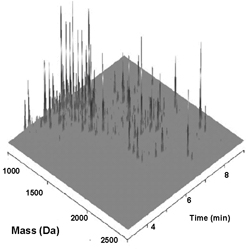 Source: H. Chen, T. Rejtar, V. Andreev, E. Moskovets, B. L. Karger Anal. Chem. 2005, 77, 2323-2331
Continuous analyte deposition.
Continuous analyte deposition, followed by the MS analysis represents an in-line approach eliminating some disadvantages of both discrete fraction collection and on-line coupling. However, in-line interfaces are not commercially available. Although MS detection usually follows separation in the in-line mode, both processes are independent and can be run unconnectedly in principle. Solidified samples can be analyzed immediately or can be archived for long periods of time for additional tests. The recently developed interfaces for MALDI analysis share some of the basic ideas of sample transfer on a mechanical support (moving belt interface).
Vacuum deposition.
In the vacuum deposition method, the sample was infused via a fused silica capillary into an evacuated chamber and deposited on a moving quartz, steel or plastic surface. Prior to the surface deposition MALDI matrix was mixed with the column effluent in a liquid junction or a tee.
The interface was used with standard micro column separations for analysis of peptide mixtures and protein digests. High separation efficiency had been maintained without observable zone broadening. Potential of high throughput multidimensional analysis has been demonstrated with parallel vacuum deposition of multiple effluents from a microcolumn array.
Rotating ball.
In the rotating ball design (ROBIN interface), the sample is deposited at atmospheric pressure onto a rotating ball, which carried thin sample film through a vacuum seal into the source chamber of MALDI mass spectrometer. Volatile components of sample solution vaporized outside and inside of the mass spectrometer. The tight vacuum seal is used here, in stead of the differential pumping typical for the moving belt approach.
Flow probes, aerosol sample introduction.
In an effort to mimic the continuous analysis mode typical for ESI ionization the interfaces based on flow probes or aerosol sample introduction were developed. Here, the effluent is analyzed virtually immediately after exit of the column and separation and MS detection cannot be taken apart.
A common disadvantage of all the continuous-flow interfaces is that the introduction of the sample is not decoupled from the laser desorption, i.e. that the liquid sample is brought directly to the desorption spot. Thus, a bulk of the solvent is vaporized together with analyte and matrix and elevates the local pressure in the ion source, which results in adduct formation and lower quality of spectra.
In the case of flow probe, a stream of a sample in a liquid matrix is delivered through the probe with or without a frit and the sample is desorbed directly from probe tip. Excess liquid may be removed with a strip of paper wrapped around the end of the probe.
A nebulizer interface has been developed for continuous on-line sample introduction in the form of aerosol. MALDI is then performed directly on the mist of rapidly dried droplets. For generation of sample droplets, a piezoelectric droplet generator may be used as well. The aerosol interfacing is relatively simple; however, inefficient sample transfer and a low duty cycle of the desorption laser limit the sensitivity.
Virtually all routinely used interfaces are designed as off-line deposition devices (spotters) that can utilize MALDI targets of commercial mass spectrometers.
- Use of the on-line and in-line interfaces is limited mostly to academia.
- A variety of spotters for off-line fraction collection on MALDI targets is available on market. The interfaces work in contact or contact-free mode, frequency of fraction deposition is up to 4 Hz, useful flow rate ranges from nL/min to mL/min and droplet size of liquid fractions is nL – μL. Spotters can accommodate up to 8 micro titration plate-sized MALDI targets with spot density up to 10 000 spots per the target.
- Selection of the appropriate spotters depends primarily on the compatibility with the MALDI target of the mass spectrometer present in the lab. Other important parameters to consider are flow rate of mobile phase, assumed peak width and length of separation.
